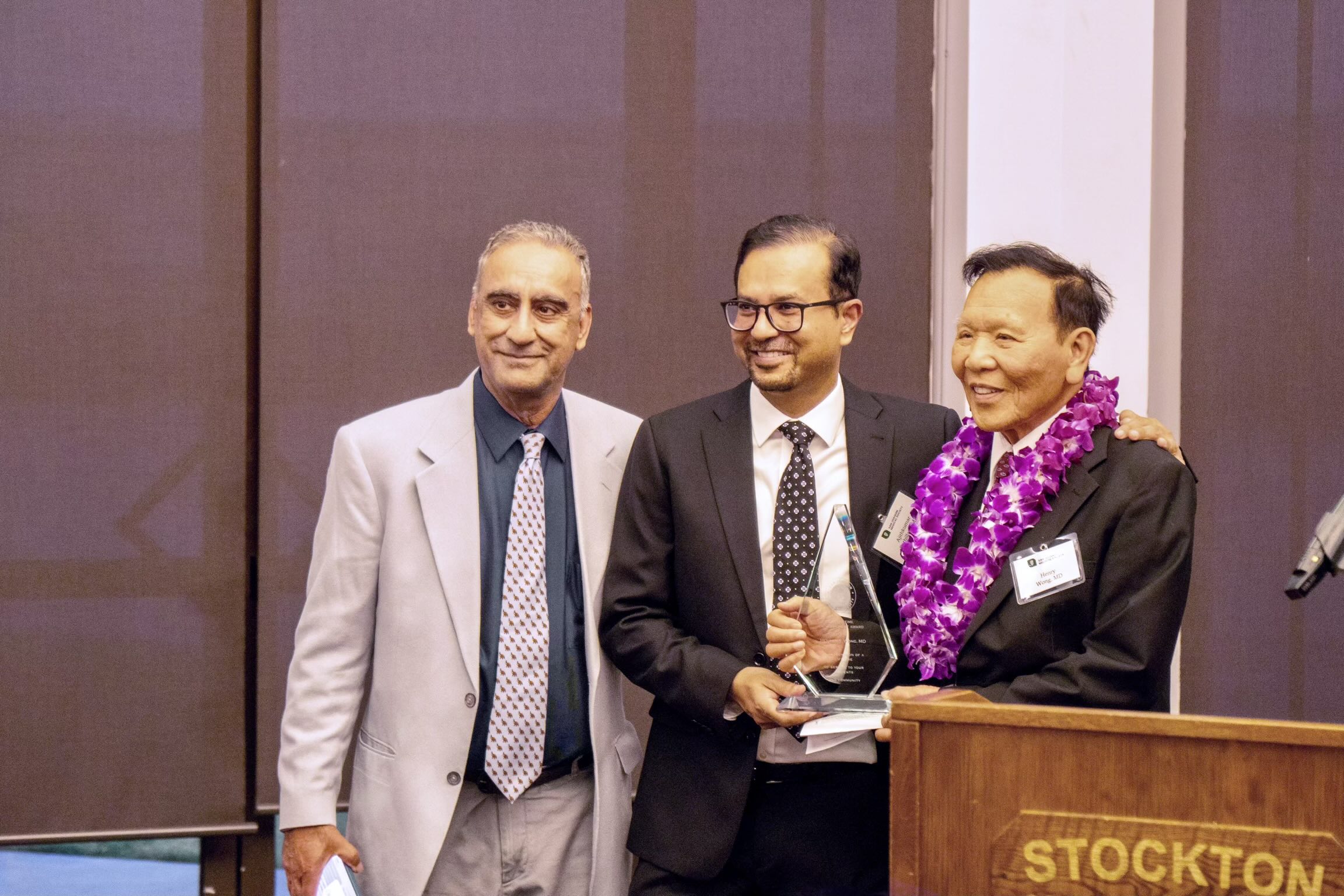
On June 7, 2026, the San Joaquin Medical Society gathered at the Stockton Golf and Country Club’s Delta Ballroom for its Annual Membership Dinner—and one of the evening’s two biggest honors went to someone very close to our hearts.
Dr. Henry Y.T. Wong, co-founder of the Dr. Henry & Sylvia Wong Foundation, was named the Society’s 2026 Lifetime Achievement Award recipient, recognizing nearly four decades of service as a radiation oncologist at St. Joseph’s Medical Center and a lifetime spent, as Henry puts it, “giving it all away to repay society for what they’ve given us.”
Dr. Ajithkumar “AJ” Puthillath, who worked alongside Henry for nearly a decade, had the honor of introducing him. AJ traced Henry’s remarkable path—from a 13-year-old who arrived in North America with nothing, to an aerospace engineering student at the University of Toronto and Princeton, to a radiation oncologist who helped build a cancer center in Stockton—and credited Henry’s late wife Sylvia as the spark that redirected him toward medicine.
“Dr. Wong, your lifetime achievement is not just the patients you treated, the programs you built, or the buildings that have your name,” AJ said. “I believe it’s the countless people who were able to dream bigger because you opened the door for them.”
Note: If the YouTube videos above and below cannot be displayed due to georestrictions, scroll down to this section for compressed MP4 files you can view on your device.
Dr. Aminder Mehdi, who began practicing oncology in Stockton a decade after Henry, shared his own remembrances—Henry’s honesty, his generosity, and a smile he wore at all times. “If there are young physicians who want to have a model to aspire to,” Aminder said, “then that model should be somebody like Dr. Henry Wong.”
True to form, Henry’s acceptance speech was warm, funny, and humble. He recalled the job interview decades earlier when he told a hospital administrator his three best qualities were sleeping well, having a good appetite, and being lucky—and got the job. He thanked Sylvia, his sons, daughters-in-law, and grandsons as “my foundation, my purpose, and my joy,” welcomed his niece Kalina who flew in from Hong Kong, and even shared a patient’s well-timed joke about a “second opinion.”
He closed with words from Sir William Osler: that medicine is “an art, not a trade; a calling, not a business”—a fitting reflection from a man who has spent his retirement proving exactly that.
It was a true family affair. Henry’s three sons, along with their partners and his four grandsons, were all in attendance. A niece even made the trip all the way from Hong Kong to celebrate with him. Of course, Sylvia—who passed away in November 2024—was sorely missed, with Dr. Puthillath noting how she “became a very successful realtor and went on to subsidize Dr. Henry Wong’s passion to work as a radiation oncologist.”
The evening also celebrated Dr. Anureet Gill, recipient of the Society’s 2026 Young Physician Award. A dedicated family physician and medical director at Dignity Health, Dr. Gill was recognized for her tireless work recruiting top physicians to the region, her full-time commitment to her patients, and her belief in preventative care—all while raising two children and staying connected to her Indian heritage by teaching Bhangra dance to local youth. Congratulations to Dr. Gill on this well-earned honor.
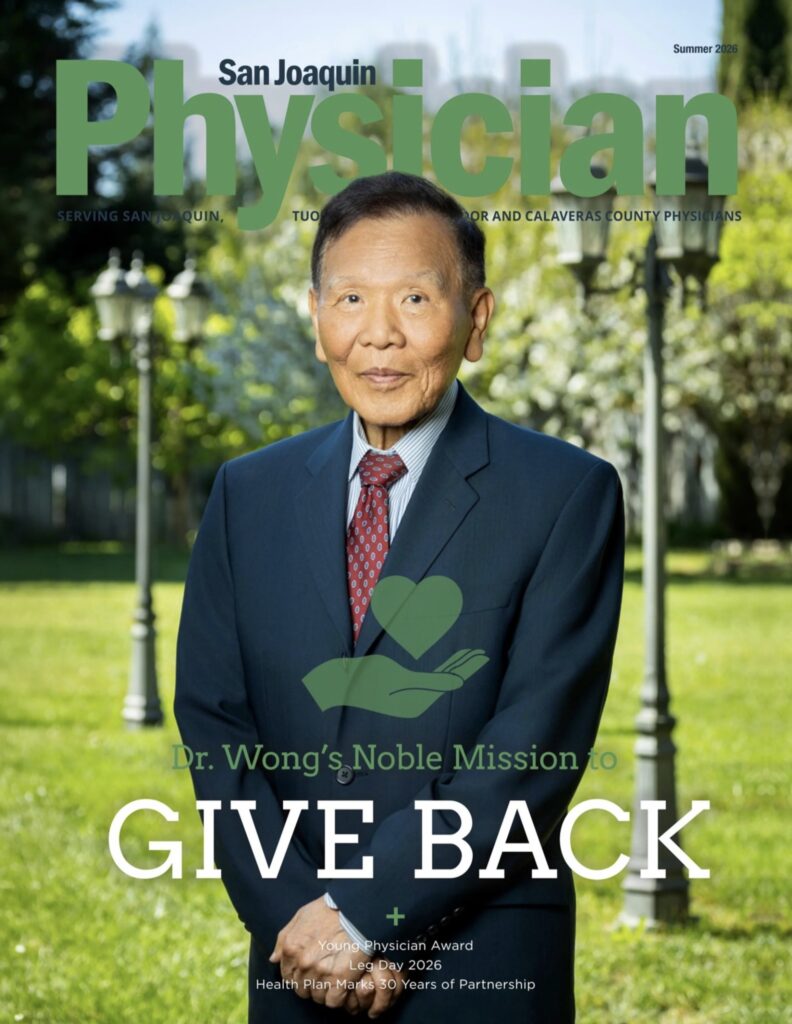
Read more about the evening, including Dr. Wong’s full story, in the San Joaquin Physician, Summer 2026 issue.
Compressed Videos
If the embedded YouTube videos above are inaccessible on your device due to geo-restrictions, you can download/view these highly compressed/low-resolution MP4 files instead.
- Dr. AJ Puthillath’s Introduction (25.6 MB)
- Dr. Aminder Mehdi’s Speech (16.8 MB)
- Dr. Henry Wong’s Acceptance Speech (32.6 MB)
Transcripts of Speeches
Dr. AJ Puthillath’s Introduction Speech
To introduce Dr. Henry Wong as he receives the Lifetime Achievement Award. I got a phone call in April when Dr. Wong was vacationing in Mexico. “Hello AJ, I would like you to do my introduction for the award.”
I was pleasantly surprised, at the same time overwhelmed. Having worked with him close to a decade, I’ve seen a larger-than-life persona but extremely grounded at the same time. Now, when you hear Dr. Henry Wong’s story, it almost sounds like three or four lifetimes squeezed into one.
He came to North America at age 13, worked in a laundry shop, studied engineering physics, then pursued aerospace engineering at the University of Toronto and Princeton. Worked in the federal government, then decided to switch to medicine and then became a radiation oncologist, and then helped build a radiation center in Stockton. Raised an incredible family, and then decided, “You know what? Retirement sounds boring, let me start giving everything away.”
I learned that Dr. Wong gets excited about big things: big dreams, big buildings, big gifts, and apparently big bridges. His son, Felix, who I met today, said that on a trip to Hong Kong, Dr. Wong was excited and enamored to cross the Hong Kong-Zhuhai-Macau Bridge—the longest sea bridge in the world. That is classic Dr. Wong; even on vacation, he’s doing infrastructure inspection.
I was curious as to why he switched from aerospace engineering to medicine. Henry happily acknowledged that the person who helped him make his decision was his beloved wife, Sylvia. He was getting frustrated with the bureaucratic nature of an aeronautical federal job and was teaching physics to pre-med students. It sort of lit a flame—why not medicine? Why not radiation oncology? And here we are now.
Sylvia, for those of you who don’t know her, became a very successful realtor and went on to subsidize Dr. Henry Wong’s passion to work as a radiation oncologist. She became among the top 1% of the Coldwell Banker realtors in the world and later started her own real estate brokerage firm. Sylvia passed away peacefully in November of 2024, surrounded by the love of her husband of 55 years, her three cherished sons—Abiel, Felix, and Godwin, they’re here—two beloved daughters-in-law, Yifan and Hsin, and four grandsons who are in attendance today.
In service to the community, their philanthropic efforts have supported many institutions. To just name a few: the radiation center at St. Joseph’s, the outpatient surgical center at St. Joseph’s, the Graduate Medical Education building at St. Joseph’s, the nursing education endowment, and the nursing program scholarship at Delta College. And that’s just a few of all his philanthropic contributions.
I asked him recently when I met him which were the most meaningful to him. He said he was very proud of the Henry Wong Building at Tsinghua University in China—sort of the MIT of China. He also mentioned the yearly health forum at McMaster University in Canada. In 2004, one of the invited speakers was Aaron Ciechanover, who went on to win the Nobel Prize in Chemistry.
Their philosophy was simple but powerful: society gave them an opportunity, and they would spend their lives giving it back. Dr. Wong, your lifetime achievement is not just the patients you treated, the programs you built, or the buildings that have your name. I believe it’s the countless people who were able to dream bigger because you opened the door for them.
Congratulations on this well-deserved honor, and please know that after a lifetime of giving, inspiring, building, and serving, you have officially made the rest of us look like we need to update our resumes. Thank you and congratulations, Dr. Wong.
I have to award Dr. Wong… Dr. Mehdi wanted to say a few things about Dr. Wong.
Dr. Aminder Mehdi’s Speech
1987… and I don’t remember, Henry, when you started your practice? [Dr. Wong answers: “77”] ’77, 10 years before me. Henry and I had something in common: I finished my training in oncology in British Columbia in Canada, where Henry was from, and so for whatever reason, we got along very well with each other.
A few words came to my mind. Number one: spontaneous. Whatever was in his mind, he would say that. No guile, there was no maneuvering. Honesty, integrity, and generosity, which Dr. AJ touched on. Very knowledgeable.
And the other unique attribute which he had—I wish I had that—he was smiling all the time. I couldn’t figure out why is Henry smiling all the time. I thought he was smiling at me, but he smiled at everybody the same way. So I felt he always had a very pleasant look on his face.
At the tumor board or elsewhere, if somebody made a joke, he always laughed very uproariously. It was not a chuckle or a giggle; it was a huge guffaw, even for jokes which nobody understood, which was very unique.
So when he retired a few years ago, I personally was very sad to see him go. I felt that St. Joseph’s Medical Center, the Stockton medical community, the city of Stockton—the city of Stockton has no idea what happens to the physicians, where’s the mayor? I just want you to know that—had lost a great physician and a great gentleman.
Since the Medical Society is honoring him, I would like to say that if there are young physicians who want to have a model to aspire to, then that model should be somebody like Dr. Henry Wong.
Dr. Henry Wong’s Acceptance Speech
Mama, did you hear what they said? Mother said yes, she loved it.
Colleagues, friends, ladies and gentlemen. I have never learned how to use the mic, I hope that this sound… I’m okay, right? Yeah. And I’m getting so old, I better read my notes.
When I first interviewed here for a job by the late Dr. Marvin Primack, he asked me to tell three good qualities of myself. I said, “I sleep well, and I have a good appetite.” He smiled and asked me the third, so I said, “I’m lucky.” He said, “Good boy, you get a job.” That’s how I got my job at this excellent hospital, St. Joseph’s Hospital. A few years later, it promoted to become the St. Joseph’s Medical Center. Wow, overnight we have a medical center. Impressive, huh?
But standing here today, I know that luck was only part of the story. The real blessing has been the people and the countries that supported me along the way. To Canada and the United States, which gave me and my late wife, Sylvia, education, opportunity, and a place to serve, we owe a great debt. We have tried in our own small way to give something back.
To my beloved late wife Sylvia, my sons, my daughters-in-law, and my grandsons: thank you very much for being my foundation, my purpose, and my joy. To my potential future daughter-in-law, Dr. Andrea Paris, thank you for coming from Spain for this occasion. To my dear niece, Kalina, thank you for coming all the way from Hong Kong just for today.
To the phenomenal nurses and secretaries that I had the honor to work with: you are the heartbeat of my practice. Thank you for your timeless dedication, your patience, and for keeping everything running smoothly every single day. I could not have done it without you.
To my patients: thank you for trusting me with your care and for bringing so much happiness and laughter into my life. In fact, I recall a patient who returned for his treatment for prostate cancer. As I was to do a rectal exam, he looked at me and said, “Dr. Wong, would you please use two fingers instead of one?” So I asked him, “Why?” He said, “I need a second opinion.”
To my esteemed medical colleagues: it has been an absolute honor to serve alongside you. Thank you for your guidance, your cooperation, and your shared dedication to our patients.
To my young colleagues: I know the demands of electronic medical records and the demands of modern medicine can get overwhelming. But whenever you can, please sit down, make eye contact, and truly listen to your patients. The human connection is still the most powerful medicine. Yes.
Sir William Osler once wrote that the practice of medicine is an art, not a trade; a calling, not a business; a calling that would require all your heart as well as your brain. And we are so lucky to belong to such a calling. Looking back on my career, I can say with certainty that it is your collective heart and your collective mind that make this medical community so extraordinary.
A Lifetime Achievement Award is a singular honor precisely because it is a recognition by one’s own peers. To everyone here tonight and to the San Joaquin Medical Society, thank you very much.